Monday, 2 September 2013

UTMB - time to move on

I just needed to get this post done while things are fresh in my mind, while the memories good and bad are still memories, and not the edited version of memories we often live with.

I pulled out of the UTMB at 12.30am on Sunday morning, at Champex in Switzerland, with 76 miles and just under 23,000ft done, about three quarters of the way around the course. I won't do a long narrative about my run but here is the story in brief.

My plan was to run a conservative race to get a finish, by working gradually up to 1-1,5 hours ahead of the cut-off times and staying there, to get back to Chamonix in 44-45 hours. I was fine as far as Courmayeur and really enjoying the race. I took the long hill up to the Bertone hut slowly, pleased that I had never felt as good on reaching this point in previous attempts. 

From this point my race went rapidly downhill. I was very slow along to the Bonatti hut, feeling very tired and unable to eat. I stopped for a twenty minute sleep on the sunny hillside along the way but felt very little better for it. I had another twenty minute rest at the Bonatti then carried on slowly down to Arnuva. I lay on the grass here for half an hour thinking that I would probably have to stop at that point, but I was still ahead of the cut-offs and knowing that this would probably be my last shot at the race I decided to carry on in the hope that things would improve. I was painfully slow up to the Col de Ferret, being overtaken by dozens of people. Worse, on the beautiful descent which one of the most runnable parts of the whole course, I could only manage a steady walk. Before the final descent into La Fouly the course goes up a number of short re-ascents; together they add a height gain of only around 600ft or so but I found them pretty soul destroying. A mile or two before La Fouly I sat on the grass, rang Jan and told her I was going to stop. Amazingly, having done that I felt quite a bit better and walked steadily down to the checkpoint.

I didn't quit straight away because I was now feeling as good as I had since the Bertone, and actually fancied some food. I had a couple of cups of fizzy water, a bowl of soup, a bit of bread and cheese. The loudspeaker announced 15 minutes to the cut-off and I thought why not, the next few miles are all down hill. I rang Jan again to tell her I was continuing. I had 4 hours to get to Champex so I did all the way to Issert at a determined fast walk. But the little hill out of Praz de Fort was a warning that things were still not right. The 1500ft climb from Issert up to Champex was the hardest couple of hours I can remember doing for many years. I needed frequent rest stops and was again passed by lots of runners going at a slow, sensible pace which would get them to the finish. I reached Champex 20 minutes before the cut-off. I knew what was coming from here, I've covered the rest of the course on several occasions, and I knew that continuing wasn't on - I wouldn't make it to Trient in the time allowed. I went straight over to the control desk and stopped.

Since first discovering the UTMB on a trip when Jan and I went out to Chamonix to do the classic "Tour du Mont Blanc" walk in 2005, I've only missed coming back each year on one occasion. Over that period I've completed one CCC race and one shortened (due to bad weather) UTMB. I've also had five (yes, FIVE) shots at the full course, which I've never completed. 

This year, conditions were perfect. I was as fit as I am ever likely to be, had spent the previous two weeks in the mountains and was confident that I would give it my best shot. I know what my basic problem is and I'll maybe cover that in a separate post. But for now I think it's time to accept that doing the same thing repeatedly and expecting a different result is probably a little short of real sanity.  I'm sure I'll come back for one of the shorter races because the atmosphere in this town over this weekend is just too good to miss, and the trail running  in the Mont Blanc range has to be as good as it gets. But as for my long, and in spite of the results very rewarding,  affair with the UTMB, I know now that it's over and I won't be back for another attempt   -    time to move on.


Tuesday, 27 August 2013

UTMB Time Again

Not much from me on the blog lately. I've been too busy sitting in the sun, drinking wine, eating pizza and pretending that all those aches and pains will go away soon, an activity otherwise known in the ultra world as "tapering". It's time for the annual Chamonix party again. I missed it last year because I was otherwise engaged in the Tor des Geants race starting over the other side of the hill in Courmayeur, but I'm excited to be back this year for another crack at this iconic event.

This isn't a wilderness experience you understand. With 2300 runners on a course that for many of its 105 miles is a singletrack, you're never going to be alone. But that is more than made up for by the stunning nature of the course, with its big climbs, never-ending descents and views to die for. And of course, the welcome you get all along the way  -  the "Bravos", the "Courages", a bonfire in every village and checkpoints you can hear long before you see them. Chamonix is completely taken over for the week by the UTMB, and of course the concurrent events, the PTL, CCC and TDS. It's a scene that every ultra runner has to be part of at least once in their career.

The weather hasn't been kind in recent years, the last time the "official" course was run was in 2009, so let's hope this year it comes good again.

So on Thursday I'll be heading over to a town that I've been visiting on and off for the past 48 years. Time for another dose of adventure.

 Bonhomme hut  - but in the race it's always dark when you get to here!

Friday, 23 August 2013

Finishing the Lakeland 100

It's only about a week now until entries open for the Lakeland 100 and 50 races. Even though (or maybe because) I have a pretty unimpressive record in the "Lakelands" myself (one 50 finish, one 100 finish and two 100 DNF's) I'm fairly hooked on the events now and it struck me when at this year's race that I saw many of the same faces, so there must be some sort of "Lakeland" community building up. I thought it would be interesting to see how people have fared in the events as a whole over the years, rather than in individual races (this will turn into a lot of numbers, if you're not into this sort of thing, now's the time to go to a different blog and read a race report!).

I started by putting all the L100 results onto a spreadsheet to see where that would lead. Now there will probably be some mistakes in this because it's sometimes difficult to see whether last year's "William" is the same person as this year's "Bill", the results for the first couple of years are fairly basic, and so on, but overall it won't be far out. I haven't included the sheet here because (a) I don't know how to do it on this blog (it's a date of birth problem, I probably need a ten-year-old to show me how), and (b) it means you can search for the names of individual heroes yourself if you're interested, they can't blame me for unwanted publicity! What I've decided to do in this particular post is to concentrate on the question asked by many Lakeland 100 suitors  - "how difficult is it to finish?" Well the honest and simple answer is "pretty hard", but if you're on the point of throwing your hat in the ring and would like to know what your chances are, you might find the following statistics interesting.

Before starting, I have assumed that a "finisher" is a runner who is recorded on the results as having a Coniston Finish. This is not the same as finishing under the 40 hour cut-off because each year a number of finishers are declared up to 2 hours after the 40 hours. I don't know how the Organisers/Marshals make this call, but it might be encouraging to anyone crawling out of Tilberthwaite with the hours on the clock running down alarmingly to know that all may not yet be lost!

I should also point out that these are statistics, and the individual performances that they summarise are just that - individual. The easiest way to illustrate this point is probably the oldest example - you toss a coin and it comes down "heads" 99 times in a row, so what are the chances of the next toss coming down "tails" - 50% of course. But with that proviso let's carry on and see how the results have panned out.

There have been 6 Lakeland 100's since the event started in 2008, and the success rate (ie the percentage of starters that eventually finished) are easy to get:

2008  -  39%
2009  -  44%
2010  -  57%
2011  -  52%
2012  -  52%
2013  -  45%

The curious will already be wondering why the years are different, why it goes down as well as up, but hold that thought for now; there is a lot more going on in the background.

Over the six years, 704 individuals have started at least one Lakeland 100. But some runners make multiple attempts:
494    runners have started the race once
137    started twice
53      started three times
14      started four times
4        started five times, and
2        started six times

And success comes sooner for some than others:
329   runners completed the race on their first attempt.
51     completed on their second (ie after one DNF)
9       completed after two DNF's, and
1       completed after three DNF's - now that's serious persistance!
So overall, your chances of success at your first attempt are 47%, but that goes up to 53% if you're prepared to keep at it. Looking at the DNF figures next........

349   runners have had one DNF (some of these have had one or more finishes as well of course)
51     have had two DNF's (again, some of these have finishes as well)
13     have had three DNF's (four of these have also had at least one finish)
4       have had four DNF's  (two of these have also had at least one finish)
You have to feel for the guys with 3 or 4 DNF's without a finish  -  how long would you keep trying? But let's wind up on a more positive note with the successes:

310   runners have finished the event once
56     have finished twice
20     have finished three times
3       have finished four times
And one runner has five Lakeland 100 finishes to his credit. On his sixth start, he pulled up at Ambleside.

So overall, 704 runners have taken on the challenge of starting a Lakeland 100, and 390 of those have finished at least once.

But for all 704 it has probably been an experience they won't forget in a hurry. So if you click your name in on 1st September, good luck on the journey!

(I was tempted to include the 50 results because many runners have done both and I was interested to see how experience in the 50 translates into performance in the 100, but in the end I decided that was a bit too geeky even for me)


Wednesday, 7 August 2013

Just another number

I try not to think about this too often, but August comes around again every year. 
 
Five years ago to the day I climbed the Cassin Route on the North East Face of the Piz Badile in Southern Switzerland, one of the classic Alpine climbs made popular by Gaston Rebuffat's book "Starlight and Storm". Modest in difficulty by modern standards, it still requires you to get up around 3000ft of continuously good rock climbing and down again before you're overtaken either by nightfall or one of the frequent thunderstorms that sneak up on the mountain from the hot Italian plain to the south. It was first climbed in the 1930's by the famous Italian mountaineer Riccardo Cassin with three companions (two of whom died in a storm on the descent), but the more interesting fact is that over fifty years after his first ascent, Cassin went back and repeated his climb -  at the age of eighty.

This time last year I was in the Olympic Stadium watching David Rudisha cruising through his 800m heat, but a few weeks later I was off to Italy for the Tor des Geants race. I wandered happily through the Itailian Alps from Sunday morning until Friday evening and was pleased enough to arrive in 270th place out of 631 starters. There were only 6 Brits in the event last year, and the speediest pair were George and Anthony who came in a good 24 hours ahead of me in 64th and 65th places, fine performances. But it was also encouraging to see that just ahead of them in 63rd place was a guy called Raymond Rebischung, winning the "over 60's" category.

Joss Naylor made his round of 70 Lakeland tops, 50 miles and 25,000ft of ascent in 21 hours, when he was 70,  and earlier this summer Gavin Bryan-Jones completed the West Highland Way in 26 hours 15 minutes at a similar age.

But my all-time hero, and forgive me if you've heard this from me before, is still a guy called Ivan Waller. I first became aware of him back in the 70's when he was still climbing, but he is summed up perfectly in a short passage written by Ronald Turnbull many years later, which reads:

Once there was a man called Ivan Waller. In 1931 he climbed behind Colin Kirkus on a seriously overhanging route called Mickledore Grooves in the days when falling off generally meant death, or severe injury if you were really lucky.

What happens to mountaineers as they get older? They just turn into older mountaineers. At the age of 70 Ivan turned to the Munros and climbed 140 of them in two years to become Munroist number 207. Three years later he backpacked across Scotland in the Ultimate Challenge event. Still in his seventies he completed the 45 mile walk of the Lakeland 3000ft peaks in a day, and climbed Tower Ridge in winter conditions without causing the slightest anxiety to my cousin, who was his companion. He also traversed the Cuillin Ridge twice, the second time escorting an older companion. He considered the Corbetts: "This may be beyond my span because I still have more than 160 to do at 81 years of age  -  but a man can try".
I've spent today climbing in the slate quarries above Llanberis, after the wet weekend and Monday probably the fastest-drying rock in the world, so I've had a nice day. Then after a few more days in the hills I'm off to France in a couple of weeks time for the UTMB at the end of the month; life's far from dull.

So thanks for all the birthday wishes. I've changed the number in the panel on the right, but it is, after all, just another number.

Wednesday, 31 July 2013

Lakeland 100 - "The most important muscle in your body is your brain"

For the last couple of years my blog has been mostly good news  -   places visited, runs run, achievements achieved, interesting things learned an so on. Well, last Saturday I had a bit of a downturn and pulled out of a race that I could and should have completed. It annoyed and frustrated me hugely, but I've had a day or two to think about it and look at some of the facts, and I think I now know what went wrong. Setting it down will be good for me and may be of interest to anyone who has had a similar experience, either last weekend or at other times.

The Lakeland 100 is a tough but by no means impossible event for the average tourist ultra-runner. I had run it twice before. In 2010 I stopped at Ambleside (with 90 out of the 105 miles completed) because I had wasted too much time in the middle stages and simply ran out of time at the pace I was able to go near the end. In 2011 I completed the course a couple of hours or so inside the 40 hour time limit feeling I could have speeded up a bit at the finish if it had been required. I know the route well and last year I finished the Lakeland 50 in just under 10 hours. This year I was generally better trained, having run PB's at the Highland Fling and West Highland Way races and finished a number of other "training" ultras comfortably and in good shape. I went into the Lakeland with a plan for 35 hours which I felt was conservative and which I was confident with, and didn't doubt that even if I needed a bit of wiggle room for unforeseen setbacks, that I would finish OK.

The outline story is that in the event I was very comfortable to Braithwaite (32 miles) but then spent the next 35 or so miles unable to eat or drink anything of note due to constant nausea. I eventually accepted that I had been running on empty for too long near the top of the climb out of Howtown (around 68 miles), so returned to Howtown and retired. I had not been remotely near the cut-off times. I got the bus back to Coniston, slept for a few hours, and felt completely fine the next morning (when the race was still going on), fit enough to have started again. So what was the problem?

Well, one or two friends have suggested that the race was too close to my run in the West Highland Way five weeks ago, but I don't really buy that. If you target one ultra as a life-changing event then you probably don't get really as fit as you need to be for it and it may take a long time to recover, but for those of us who participate fairly regularly (I've run over 40 ultras in the last seven years), then you get fit enough to compete at your chosen level, recover quickly and move on. I've never had the sensation described by some people as "still having the last race in the legs" three or four weeks later. I had no major muscular or joint problems. I was worried about a chronic knee problem going in to the race, but I strapped it up well and on the day it caused no more than a minor annoyance at times. I know how to look after my feet so I don't normally get blisters. I've practiced hydration and fuelling over a lot of events so I think I know what works for me. Conditions were not ideal (a bit warm to start with followed by rain) but certainly not the extremes you get in the Alps. So for a day or two I was puzzled, but I tried to remember my race in detail to see if I could work it out.

Successful world-class coaches such as Clive Woodward and Dave Brailsford talk about dramatically improved performance coming from the sum of a large number of small gains, and of course this works for everyone, not just elite athletes.  I think what I learned last weekend is that the reverse is also true; performance can be severely compromised by an accumulation of small errors of judgement. You get one or two things wrong and the process starts; if you then don't use your brain to recognise and correct them , you just get into a downward spiral to eventual failure.

Let's go back to the beginning. 6pm on a sunny Friday evening in Coniston and we were away. The "warm-up" legs over to Wasdale went easily and I reached Seathwaite in 1hr 39mins (plan 1,45), Eskdale in 3,23 (3,30) and Wasdale in 4,56 (5,00). The views were stunning, particularly looking back to Burnmoor Tarn with a stream of headlamps reflecting off the still water, and it felt a pleasure and a privilege to be on the course. I should mention two things here though. Firstly, I don't get thirsty, not running, not even in a normal day. If I go for a walk in the hills a litre will keep me going for 8 hours or so in normal conditions. So the received wisdom of "drinking to thirst" just doesn't work for me, and I've had to work out what I think I should take in. In ultras I normally drink about a litre every three hours in the early, more active parts of a race, going down to a litre every four hours after tiredness slows me down. I don't know how this water intake compares with other runners, I would be interested to know. As it was a warm evening at the start, I upped this a bit for the first leg or two, then cut back to a litre per three hours as it got cooler between Wasdale and Braithwaite. I found the climbs over the passes easy enough, kept jogging the downhills and flats, and had drunk 3,5 litres by the time I got to Braithwaite, which I reached in 9,41 (10,00 plan). 

The second issue I have is that I don't like the taste of water on its own, so I'm always playing around with different flavours. On Friday I was using SIS GO Hydro Tablets which I hadn't used much before but which had a pleasant lemon flavour. But because this is an electrolyte I was not taking Succeed (S-Caps), which I usually use when hydrating with "non-electrolyte" drinks. This may have been mistake No 1, playing with a non-familiar electrolyte. I'm not sure, because latest thinking seems to be that electrolyte supplements are over-rated anyway, but the wisdom of doing this certainly played on my mind a bit later in the race.

However, on checking back, my first clear mistake in this first 30-odd miles is that I ate too much in relation to the water I was drinking. It's easy to eat early on in a race, particularly if you choose to walk all the uphills, so with ginger cake, flapjack, soup (brilliant at both Wasdale and Buttermere!) supplemented by regular gels and shotbloks, I took in about 1500 calories before Braithwaite. Now I think the figure is that you can digest while active is around 200/300 calories per litre of water, which meant I needed nearer to 5-7 litres instead of the 3,5 litres I had drunk. So by Braithwaite, although I didn't know it, I was already either over-full or dehydrated.

Braithwaite is a sort of oasis in the Lakeland 100, the end of the really tough ground, the first place you can get inside for a bit of a break, the first place serving real food. I was pleased with my efforts so far so rewarded myself with two full bowls of pasta and sauce, and a couple of cups of tea. You can see where we're going here (although I couldn't at the time), the food to liquid balance, already bad, just got a lot worse. Walking out of the hall I suddenly didn't feel great, but just put it down to eating too quickly, I felt I just needed to digest the food so decided to walk along the road and up the hill to the Glenderaterra valley. Once past the Latrigg car park I started running all the flats and downhills again, feeling that I was going strongly, although I still felt queasy and the SIS drink was now a real turn off. I drank nothing during the leg but had a cup of tea at the Blencathra checkpoint.

Another error was coming up here. At this point, in my bit of the field it was mid-morning and starting to get hot. I read a report recently about the recent extra-hot Western States race this year where the RD at the briefing said something like "It's going to get hot. Forget about your pre-planned splits and slow down. Drink plenty and you'll survive".  What happens if you go too fast in hot weather and don't drink enough is that your body temperature rises and you feel nauseous. In the 18 miles from Blencathra to Dalemain I drank maybe 750ml of water in tiny sips, plus a cup of tea at Dockray. I had stopped putting the SIS tabs in but could not drink enough water in one go to use the S-Caps (you need a good slug of water when you take one or you tend to get immediately sick). So no electrolytes from here. On the walk up to the Old Coach Road I passed Nick Ham who was struggling. He said he felt he had overdosed electrolyte and might have to pull out (he didn't, he went on to finish in under 34 hours) but that didn't help my current frame of mind in trying to work out what was wrong with me. And instead of slowing down I speeded up. I had this idea sort of pre-programmed into my brain that this is the part of the course where you have to get a move on because it's so runnable, jam for nothing sort of thing. The result was that I did this 18 miles almost an hour faster than I had planned, arriving at Dalemain in 16hrs 52 min (against an 18 hour plan).

I had it in mind that having a good rest at Dalemain would put me right. I lay down for a quarter of an hour or so at the checkpoint, chatting briefly to Jon Steele who was there at the same time and just getting ready to leave. I then managed to drink two cups of Coke and two cups of tea slowly, and had a bowl of beef stew. After about 45 minutes I didn't really feel any better, but it was hot and there was no real shade either inside or outside the checkpoint marquee so I decided to push on. I walked steadily along to Pooley Bridge then up the hill onto Askham Fell, with a continuous stream of good wishes from Lakeland 50 starters coming past me. When the ground levelled out before the Cockpit everyone around me was running, so I started to run too (why, I ask in retrospect!!), and kept up a steady jog all the way to Howtown which I reached at around 1.40pm. I hadn't drunk anything since Dalemain so felt pretty rough when I arrived.  I was even more determined this time to get sorted out so I just lay down on the grass at the back of the checkpoint and sipped my way through another couple of cups of tea. I told the checkpoint staff I was going to be there a while. After an hour or so I still didn't feel any different but I reasoned that walking slowly wasn't going to be any worse than just sitting around doing nothing, so I set off again.

Now that the main rush of the Lakeland 50 had gone through, I was going no slower than the people around me as I made my way up Fusedale, overtaking some people on the way. But by the time I got to the point where the path starts its final right-left push for the top my energy level had pretty well reached rock bottom. Normally I never stop on climbs, but on this one I just had to sit down. I considered the situation. It seemed to me that I wasn't going to get through this bad patch, which had now been going on for something like 10 hours. I was no nearer to being able to drink any real volume of water than I was at Braithwaite more than 35 miles back. I might get over to Mardale but it was unlikely that I could get any further. Decision made, it was over for today. I turned round and went slowly back to Howtown, where I retired from the race at 4.25pm. As I sat around at the checkpoint waiting for the bus back to Coniston, L100 runners were still arriving at Howtown, well over 3 hours after I had first got there; some of these people finished the event through to Coniston.

Getting back to Coniston took a while, I was back at maybe 10pm. Getting off the bus, I went immediately to the food counter in the school to satisfy a craving for lemonade and crisps. After that I felt fine.

So what is the learning from this? Well, from the story so far you can see that I made a number of mistakes which led to dehydration, and I then carried on making mistakes which prevented me from resolving the situation, which I could otherwise have done at many points throughout the day. Even at Howtown, had I sat around for two or three hours instead of one it is very likely that I could have got going again and completed the race. So my biggest takeout from this failure is that dehydration affects your judgement  - once your brain stops working logically then you're in danger of getting out of control. I'm never going to let this happen again. Pulling out of an event is a rare occurrence for me, and it hurts!

Practically, I'll do what I should have done long ago, take weight measurements over plenty of long training runs to get a better idea of how much fluid I do actually lose over a range of conditions, so I know how much I should be drinking (It's a genuine problem, I went out rock climbing near Llanberis yesterday; we were away from the car for over 6 hours, I drank nothing and didn't feel thirsty). I'll pay more attention to the calorie to fluid balance in future. And I'll try and get it programmed into my brain that if things are getting bad, the only practical way out of the situation is to stop and sort it out!

And the Lakeland 100? Well, after success in 2011, I thought I had its measure. Now there's a ghost to be laid. I'll be back next year.


Saturday, 13 July 2013

Pacing and the Lakeland 100

With the Lakeland 100 coming up in two weeks I thought I'd better re-familiarise myself with bits of the course that I haven't seen for a couple of years, particularly those done in the dark, so yesterday morning I got myself up early to be parking in Coniston at 6.30am ready for a long and probably hot day.

It's surprising how much the countryside changes, or is managed, over a period of two years. The old rocky defiles of the Walna Scar Road have been filled in to make it almost motorway-smooth and the deforestation around Grassguards Farm has changed its appearance completely  - and the new forestry road there has helped dry out the very boggy section to our advantage! Even the minor details change over time. The first time I reccied the route back in 2009, the final turn up to Sail Pass before Braithwaite was so obscure that I missed it and had to go back. Then it grew a cairn, now the cairn has got big enough to fall over and the "turn" is quite clearly the most-used path at the junction  -  the Lakeland 100 is creating its own trails, as the Bob Graham has done over the years. Well, the day was as hot as predicted, so I walked anything that smelled of uphill and jogged the rest at a very modest pace, and eventually arrived at Braithwaite after nine and a half hours on the go. Good enough. A quick ramble from Ambleside to Coniston next week to remember the fell after Tiberthwaite and I'll be good to go. I ran this in the Lakeland 50 last year but just made it to the finish in daylight, and things change in the dark.

So I started putting together some sort of plan for the race. Now the Lakeland 100 is quite a gnarly event, not to be taken lightly, and a certain amount of unpleasantness ensues if you get it wrong. By my own rule of thumb I should be able to get round in about 30 hours (3x Lakeland 50 time), but my ambition this year is for a completion in good shape, in whatever time it takes - I don't want a long recovery period afterwards with the UTMB coming up 5 weeks later. Allow a few hours spare for the wheels to come off occasionally and this means I'm targeting 35 hours. In any case my record in this event isn't great; in 2010 I stopped at Ambleside, by that stage going too slowly to complete in the 40 hours, and in 2011 I finished in 37:39 having had to stop for a longish sleep at Kentmere, so a 35 hour plan seems sensible. 35 hours is an average of 3 miles an hour start to finish, including stops. Over the years, I've come to the conclusion that the strategy for completing this race and enjoying most of it (we do this for fun remember) has two key elements:

1. Get to Braithwaite feeling good. By here, you've all the really tough stuff behind you but it's still only one third distance. If you're feeling bad by here, the rest is going to hurt quite a lot.

2. Don't waste energy early on running in places where you should walk. There is a lot of easy ground in the middle and later parts of the course, and having to walk this at three miles an hour or less is a great way to ruin your overall average.

So I put together an initial plan which sees me at Seathwaite in 1.45, Wasdale Head in 5 hours, and Braithwaite in 10 hours, and so on. Out of interest, I then checked this against Nick Smith's time split predictor based on the 2010 race actual finishes  -  http://climbers.net/race/Lakeland100-2010. What I found was a bit of a shock. Plugging a 35 hour target  into Nick's model told me I should be at Seathwaite in 1.21  and Braithwaite in 8.31 -  suicidally fast according to my thinking. But there are two linked factors at play here, both coming from the way that Nick has constructed the model (don't get me wrong, this is not a criticism, it's a great and fascinating tool, you just have to understand the way that it works).

The figures are based on the times that runners actually took in the 2010 event. I looked a bit closer at the sensitivity of the target time, and a very abbreviated spread is shown below:


You can see for example that if you target a 33 hour finish the model tells you to start much more conservatively than for 35 hours. What happened is that the 35 hour result was skewed by two competitors in particular who started out at the model's 30 hour pace then "blew up" and finished very slowly indeed. So if you use this model to have a go at planning your race, check the sensitivities on either side of your target before you go firm on a plan.

But the second and more important point is that the model reflects what runners actually did, and not perhaps what they ought to have done. My stake in the ground here is that I believe that the majority of runners, and especially middle to back of pack performers, start far too fast when competing in long distance events. It may appear that I'm diametrically opposed to Stuart Mills here (we've had some debates about it!) but I don't think I am. A couple of points to think about:

1. I've analysed the results of a lot of races over the past few years, and one very consistent trend that comes out is that over the course of a race, slower performers slow down significantly more than faster ones. The good guys keep running all the runnable bits, they just go slower. The weaker performers are walking everything way before the end. Now assuming that you are unlikely to walk at much faster than a 15 minute mile pace, whereas even a slow jog gets you 12 minute miles on level ground or downhill, being able to run the runnable stuff for as long into the event as possible pays huge dividends. To do this you need to conserve your energy early on, not run uphills at a marginally faster rate than you could walk them.

2. As everyone says, overall performance in ultras, and particularly how you fare when you have a few miles already done, is largely governed by your mental attitude. How do you stay feeling good, and therefore focussed on the task in hand. Some runners (most likely near the front) will get this from feeling competitively successful, beating their peers, having a chance to win and so on. I know people who feel good so long as they are ahead of their plan, beating their splits  - a danger here of course is that if you fall behind your plan the motivation takes a big knock. After well over 50 marathons and ultras in the past few years I know what keeps me going - I like to feel, until the finish is comfortably in sight, that I have "something in hand", I could go faster if I chose but I'm taking it easy. You only get this by starting conservatively. I've done races where it hurt from a quarter of the way in; I don't like it and I try to not let it happen these days - if things start to feel tough I slow down, have a rest, get it sorted now rather than hanging on hoping that things will improve. I've done marathons with both negative and positive splits; we could argue forever over which gets you the fastest time on the day, but I know which ones feel better, the ones where you're accelerating to the finish rather than desperately hanging on. Of course everyone slows down in an ultra, but it's the perceived effort that's the key. When you're 50 miles in, does it still feel fun? Remember, we're not talking here about winning the race or getting your absolute best time, we're talking about finishing the event successfully and in good shape.

So as we set out on the 26th July, I'm expecting to be one of the last to reach Seathwaite. But I'm also hoping to be able to run the newly-surfaced Garburn Road down to Troutbeck a few (!) hours later. If you're interested this is my plan:


But I have a number of ex-military friends who say that the only thing that you can guarantee about a plan is that it never survives the first contact with the enemy.

Thursday, 27 June 2013

West Highland Way Race 2013


I love this race. No straightforward reason, I'm not Scottish and it doesn't really play to my strengths  -  too much running and not enough technical ground for my liking  -  but put to the ultimate Desert Island Discs test, if all but one of your selections were washed away, then yes, this is the one that I would save.

Maybe it's the simple logic of the course; you start somewhere and head for somewhere else, a real journey rather than a constructed circle of difficulty getting you back to where you started. Maybe it's the scenery, on a scale we don't get south of the border. Maybe the escalating wildness from the rural farmland of the lowlands to the empty loneliness of the Lairig Mor. Maybe the commitment required, for there are many sections where you don't see habitation for many miles and there is no option of ducking out, just a choice between going on or going back. Maybe all of these, but I'm sure the main thing that sees me and many others returning year after year is to share the experience again with all the folk who organise, marshal, support, and run this iconic event. The West Highland Way "family" is indeed real.

This year the weather gods were much kinder after two years of deluge, Race Director Ian Beattie and his team upped the professionalism a further notch with immaculate organisation including chip timing for the first time, and the runners responded with an avalanche of superb performances.

Paul Giblin arrived in Fort William just 15 hours and 7 minutes after leaving Milngavie, breaking what we all thought was an outstanding record already by a cool half hour plus. The figure that I personally find hard to get my head around is that Paul covered the 95 miles, with its 14700ft of ascent, rocky and bouldery trails, stream and road crossings, and countless gates and stiles, at an average pace of 9 minutes 33 seconds per mile - amazing. Marco Consani got second place with a time that would have won the race in every other year of its history except for the record-breaking runs of Jez Bragg, Terry Conway, and of course Paul. Richie Cunningham came third, recording his fourth sub 17-hour finish, a consistency no other runner can come near. And Gareth Bryan-Jones finished in just over 26 hours at the age of 70, beating nearly half the starters in the process. For the ladies, Rosie Bell retained her title with a substantial improvement on her personal best, which she needed because in the nine weeks since the Highland Fling Race, Lorna McMillan emerged as a rising star to push her all the way. This year, the Scots claimed their premier ultra as their own!

Against this background my own day out seems pretty pedestrian, but I'll tell the story anyway.

After managing to crack 24 hours back in 2010, I had rather lost my way with the race. For the past two years I'd come without a real plan which resulted in two mediocre performances. This year I thought it was time to give it my best shot again.  I did a bit more "WHW-specific" training and decided I was good enough to go for the Saturday finish, that is to complete the course in just under 23 hours. To give myself a bit of wiggle room I put together a schedule for 22 and a half hours.

The usual suspects were there in the station yard on Friday evening. We spent time meeting and catching up, wishing each other luck, complained that we hadn't done the training we should have done, then we listened to Ian's briefing and headed off into the night. I had decided to start more aggressively and set myself a target of 2:09 to Drymen, which I beat by 5 minutes and still ended up squarely in the second half of the field  -  it seems almost everyone starts this race fast! My strategy after this initial "sprint" was simple  -  walk everything uphill and jog the rest, hopefully to the finish.

As the darkness turned into mist, we had an inkling that the promised very wet forecast wasn't going to be right. In fact, the day turned into almost perfect running conditions, cool with almost no wind, just the occasional heavy shower. Garabhan and Conic were uneventful and I sidled in to the first checkpoint, Balmaha (19 miles), on 3:34 in 77th place. I'd told the crew (Jan and Julia at this stage) to get me out of checkpoints as quickly as possible  -  my schedule didn't allow for stops but I had 30 minutes overall to play with - so it was a quick milkshake, change the water bottle and off along Loch Lomond.

I'm always surprised at how quickly a field of nearly two hundred gets spaced out along this course, and apart from a short while with Ian Rae I was on my own for most of the way to Rowardennan (27 miles) which came up in 5:18, spot on schedule. Looking at John Kynston's post-race spreadsheet, I now know I was 54th fastest from Balmaha to Rowardennan, so speeding up relative to the field but it felt easy enough. I know that I have to be careful from Rowardennan to Beinglas because it's country that I enjoy and can cover fast, but if I overdo it I know that I will pay later, as I have on several previous races. So I carried on walking every hill and arrived at Inversnaid (34 miles) in 6:55. A very midgie place but a novel idea of a "midge-free tent" provided by the marshals here, so I snuck inside for a custard and my first sit-down since Milngavie.

I walked almost all the way from Inversnaid to Beinglas, most of it in company with Keith Ainslie who was running his first WHW and hoping to get under 24 hours (he did!).  Even at a gentle pace the miles seemed to pass quickly. We caught up with Tony Thistlethwaite after a couple of miles or so. Tony is a fellow "vintage" runner who I have shared many miles with along this course over the years. He kept saying that he wasn't bothered about the time, he just wanted to finish as this would be his tenth completion, but Tony is a class act and still went on to finish well under 23 hours. Beinglas came up in 8:38, just a couple of minutes ahead of plan. What a difference an hour or so makes. In this year's Fling I was here in 7:30 and knew I was going to have a bit of a battle to keep going - now I was absolutely fine and raring to continue. I was 45th fastest from Rowardennan to here, still speeding up but still conservative. It was good to see Jan and Julia again but this was another "splash and dash" stop so I was there only a couple of minutes.

I left Beinglas with Tony but he was jogging some of the uphills so he soon opened up a gap of a few hundred yards. I've had some tough times on this bit so I took it gently. The only thing of note was how clean and dry the track was in the area where the cows normally congregate. No cows today, nor the hundred yards or so of ankle-deep agricultural slop that goes with them - a real bonus. I caught Tony again at the big gate above Bogle Glen - the halfway point of the race in distance - and we continued more or less together to Auchtertyre (50 miles), which I reached in 10:49. I was 27th fastest from Beinglas which really surprised me as it didn't feel fast at all. I think I maybe know the ground so well now that I know where to run and where to save energy on this mainly uphill stretch.                                         
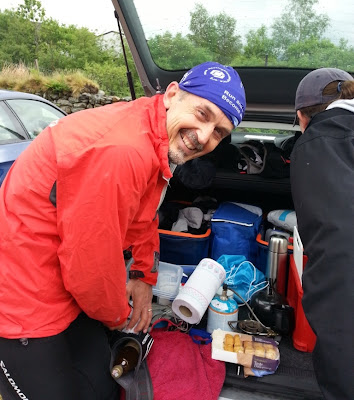
Topping up supplies at Auchtertyre

Auchteryre is lunchtime, especially if you've been up since 1.00am, but I've made the mistake in the past of eating too much too quickly here and then not being able to move at a more than a waddle for the next several miles, so now I grab the sausage rolls, Mars bars, ginger beer and so on and eat them at a more leisurely pace on the long uphill out of Tyndrum. This meant I was able to run quite a bit of the few miles from Auchtertyre to Tyndrum before this. As I walked up the hill munching away Jon Steele came down the track in the opposite direction. Jon and Shirley were not running today but supporting Garry Scott, who was always half an hour or so ahead of me -  and an hour and a quarter at the end!

From the top of the hill, I know it is really easy running all the way to Bridge of Orchy so I carried on at a steady pace all the way, breaking my rule of not running the uphills, because on this stretch they are so gentle. At Auchtertyre I had thought I'd seen Jan for the last time for the day, and Julia for the last time until Kinlochleven. John was unable to join the team at the start because he'd been to a friend's wedding on the Friday, and we'd speculated what time he would be able to arrive, but he'd contacted the ladies and they were meeting for lunch in the Real Food Cafe in Tyndrum after I was through Auchtertyre. The plan was for the ladies to go to Fort William, check in and have some sleep while John covered the Bridge of Orchy and Glencoe stops. So I was quite surprised to see them all at our usual meeting point in the station car park. Julia's greeting was "Slow down, you're going too fast!". I was into the station in 12:46, about 15 minutes ahead of plan, so maybe I should have taken it a bit easier but it felt good at the time. They had decided that Jan would stay in Fort William after this stop, but that John and Julia were happy to go through to the end.

I used a bit of my time cushion to have a cup of tea, then set out down the road to the Bridge of Orchy checkpoint (60 miles) which I reached in 12:56. Tim and Muriel Downie were marshalling here this year but only Muriel was in evidence as I checked in. She said Tim was back in their camper. I set off at a steady walk up the hill but before I'd gone a hundred yards or so I heard running footsteps behind me, and Tim came flying past. "Couldn't let a West Highland Way Race go by without overtaking you at some point!" We walked a few yards then he wished me well, and I carried on up to Murdo and the jelly babies. At least it wasn't raining continuously on Murdo this year. He told me that John Kynaston was half an hour or so ahead of me, but he also had the news that Paul Giblin was well through Kinlochleven and looked on for a new course record. We chatted a minute or two then I pressed on, enjoying the downhill to Victoria Bridge.

I had already decided that my "walk the uphills" strategy had to be compromised for Rannoch Moor, because it's very nearly all uphill and would take forever walking. In previous years I had adopted a run/walk strategy, walking for a few hundred yards every so often to get a breather. This time, apart from a couple of short sections on the first long hill, and the last steeper half mile to the final summit, I ran the lot. On this last steeper bit I passed Karl Zeiner, which surprised me as he is a much better runner than me but he was obviously going through a bad patch (he came through it OK and finally re-passed me shortly after Lundavra)
Approaching Glencoe checkpoint (photo Jonathan Bellarby)

I felt OK coming down the slope to the checkpoint, but for the first time that day I also felt that I'd already come a long way - not quite the spring in the step I'd had at Balmaha!

I reached Glencoe in 15:22 which was 27 minutes ahead of my plan. The leg from Bridge of Orchy to here was my best relative to the rest of the field, I was 22nd fastest.

But I'd gained a bit more "cushion" and I was still going relatively well and feeling very positive that this was going to be a good year for me. Soup and tea at the checkpoint, flat coke and gels to go and I was away down the road towards Kingshouse. I felt I was slow over the Devil's Staircase leg, but on reflection I walked the ups steadily, jogged the downs and flats and didn't stop at all, so it was still done in 2:45 compared with my 3:00 plan (again 27th fastest).

And so to Kinlochleven. Through the checkpoint door and there was John K. I was pleased to have finally caught him but I knew I wouldn't see him again  -  he looked fighting fit and ready for action, but I was now feeling very tired. I sat on the back of the car with John and Julia and took stock. John had already decided he would run with me over the last stretch. I had reached Kinlochleven in 18:07, in 32nd place overall.  I wasn't feeling great, but I was as good as I've ever been at this point in the race, and much quicker. I had almost 5 hours to get to the end and still break 23 hours, but 22 was tantalisingly close. On the other hand I didn't want to push too hard and blow up with the prize in sight. I wasted 10 minutes or so changing my shirt and drinking a couple of cups of tea. Ian Beattie wandered past, come on he said, three and a half hours from here, you'll be there before eleven o'clock.

No excuse for hanging around longer so John and I were away, leaving Julia to drive around to the finish. I was stronger up the hill to the jeep track than ever before, still overtaking the odd runner. The Lairig Mor, which holds a lot of memories for me of just wanting the whole thing to end, was OK. We walked the ups and ran the downs, although "running" was a very relative term by this stage, I doubt whether we made much more than 12 minute miling at best.
In the Lairig Mor, photo by Wilderness Response Team
But it was daylight, and dry, and the trees appeared much quicker than usual. Soon we could see the white gazebo of the Lundavra checkpoint, and a wisp of smoke from the bonfire. Then we heard strains of the "Rocky" theme drifting towards us. The Lundavra checkpoint was brilliant, with the fire, music and party atmosphere it was like something on the UTMB.

But we weren't stopping. I think I said something like "I'm totally knackered now, but I will finish today" to Caroline as I went past. My elapsed time was 20:25. An hour and a half from here to the end would have done it, plenty of people cover the ground in this time. But it wasn't going to happen for me today. I just got slower and slower up the hill to the forest, then quite unexpectedly a couple of coughs turned into 20 seconds of retching and I had to pause for a few minutes. I got going again OK but decided I better not blow it at this stage. I said to John that I would walk now until we were up the last climb.  A lot of runners passed me in the two miles between this point and the start of the final run down to Fort William. My 32nd place at Kinlochleven turned into 41st at the end. When we were in the forest it was tempting to run the downhills but I knew I was very tired and didn't want to fail on the last uphill. But it was great to cover this section in daylight for the first time, we only clicked on torches for a few yards in the depths of the trees, then they were off again to the finish. Eventually we started the last climb and it went steadily enough, with Donald Sandeman in his tartan shorts as ever passing me just before the top. Once the final uphill was done, we got into a steady jog all the way down the wide forest road to the Braveheart Car Park, and as we hit the road  John phoned the ladies to say we were near to the finish.

With maybe half a mile to go a figure appeared out of the gloom, running towards us. It was Tim Downie. "What kept you, I've been waiting for you?" he said. My rather ungracious reply was "I'm going to beat your time, Tim!" "And about   ****ing time too!" was the response. The three of us jogged on to the finish.

With Jan at the finish
After the congratulations and family hugs, I said "What I could really do with now is a beer !" A guy who I had never seen before in my life immediately produced one, had the cap off, and gave it to me. Everyone you meet involved with this race is special.

My time of 22:23:13 was a personal best by an hour and 11 minutes, on my seventh completion of the course. I would have settled for that at the start of the day.  Had I got home in, say, 22:50, I would have thought job done, no way you're going to beat that, relax and smell the flowers in future. But 23 minutes? It must be possible to find that from somewhere, we're learning all the time.........

The prizegiving next morning and session in the Nevis bar Sunday evening were as good as ever, great to catch up with people and hear their tales. It was particularly good to learn of runners who had been able to lay some ghosts after a disappointing year or two, producing times that truly reflect their abilities.

Someone once told me that the seventh finish is the dangerous one. Six goblets is a nice set, seven and you're probably in for the long haul. I'm afraid for me there was never any doubt. I shall keep turning up at that crazy hour in Mingavie station yard every year until someone says I can't.